

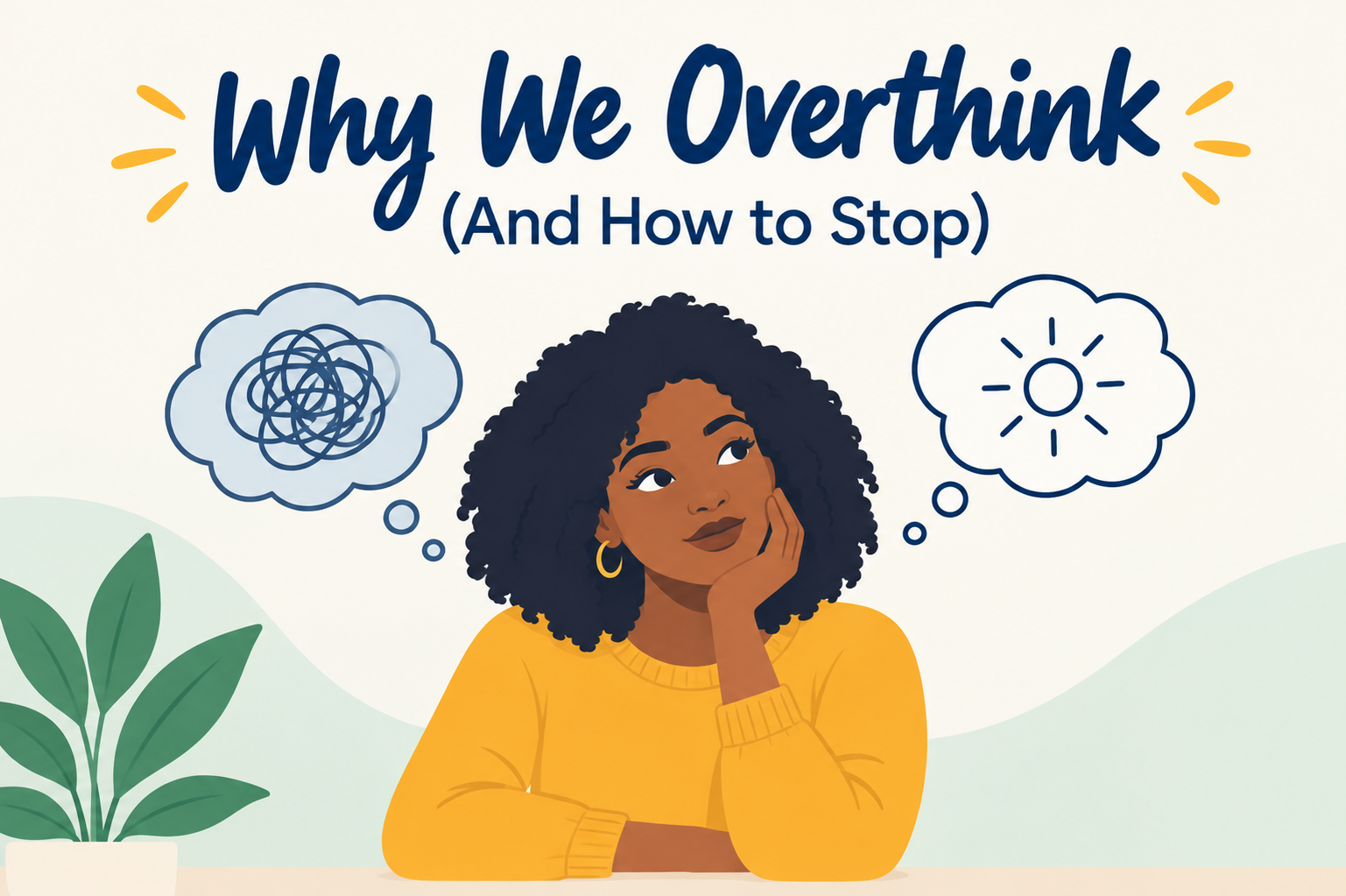
On the mind that won't stop checking its own work, and how to finally let it clock out.
There's a specific hour that belongs to overthinking, and most people know it without needing to be told: lying in the dark, tired enough to sleep, and instead replaying a message you sent four hours ago, wondering if the word you chose landed wrong. Or standing at a decision that objectively doesn't matter that much — which offer to take, which reply to send, which route to drive — running the same five arguments in a loop that produces no new information, only more laps.
The strange thing about overthinking is that it feels, from the inside, exactly like diligence. It feels responsible. It feels like the mind doing its job, being careful, refusing to move until it's sure. This is the disguise that makes it so hard to catch and so hard to stop: it wears the costume of thoroughness while actually delivering none of thoroughness's benefits.
What overthinking actually is
Thinking solves problems. Overthinking is what happens after the problem has already been solved, or was never solvable to begin with, and the mind keeps running anyway — not producing insight, just producing motion. It's the difference between turning a key in a lock and rattling a doorknob that was never going to open.
The tell is repetition without progress. If the fifth pass through an argument contains information the first pass didn't, that's thinking. If the fifth pass is just the first pass wearing a different mood — the same worry, slightly more anxious, no new facts, no new angle — that's the loop. Loops don't converge on an answer. They just spin, burning attention as fuel, and the spinning itself starts to feel like it must be accomplishing something, precisely because it's costing so much.
The uncertainty it's actually trying to solve
Overthinking rarely targets the decision itself. It targets the discomfort of not being certain about the decision — a subtly different target, and one that thinking cannot actually hit.
Most of the situations that trigger a spiral share a structure: an outcome that can't be fully known in advance, and a mind demanding certainty before it will let the topic go. But certainty, for almost anything that matters, isn't available. You cannot think your way to a guarantee that the message won't be misread, that the decision won't be regretted, that the risk won't materialize. The mind keeps searching for a stopping point that plain thought was never going to provide, because the actual stopping point requires simply tolerating that you don't know — a different skill entirely, and one no amount of additional analysis substitutes for.
This is why more thinking rarely resolves it. You're not short on analysis. You're short on tolerance for the analysis being incomplete. Adding more thinking to a tolerance problem is like adding more fuel to a car that's stuck, not out of gas.
Why the mind won't just drop it
It's tempting to treat overthinking as a bad habit, easily corrected by deciding to stop. In practice, the loop persists because it's quietly rewarded.
It offers the illusion of control. As long as you're still turning a problem over, some part of you believes you're still doing something about it — actively managing a risk rather than passively enduring one. Stopping feels, falsely, like giving up.
It protects against future blame. If a decision goes badly, having agonized over it in advance offers a kind of alibi: I did think hard about this. The suffering becomes evidence of diligence, even when it changed nothing about the outcome.
It postpones the vulnerability of commitment. As long as a decision is still being weighed, it hasn't been made, and what hasn't been made can't yet be wrong. The loop, uncomfortable as it is, can feel safer than the exposure of finally choosing.
None of these payoffs are irrational. They're just payoffs that cost far more than they're worth, and the mind keeps making the trade because the cost is diffuse and delayed while the reward — however small — is immediate.
What actually interrupts it
Name the loop while you're in it. The single most effective move is also the simplest: noticing, mid-spiral, this is the loop, not new thinking. That small act of naming creates a sliver of distance between you and the thought, which is often enough to break the automatic quality that makes loops feel involuntary.
Set a decision deadline before you start. Open-ended deliberation has no natural end point, so it manufactures one out of exhaustion. A deadline — even an arbitrary one, even five minutes — gives the mind a legitimate place to stop that doesn't depend on reaching impossible certainty first.
Ask what new information would actually change the answer. If nothing would, no amount of further thought is doing useful work, however urgent it feels. This single question deflates most loops almost instantly, because most loops don't survive contact with it.
Separate weight from time. Big decisions deserve real thought; small ones don't, and the loop rarely distinguishes between them with any accuracy. A useful habit is asking plainly, does this decision's importance match the time I'm giving it — and downgrading the time when the honest answer is no.
Externalize it. A loop kept entirely inside the head has no edges and no end. Written down or said out loud to someone else, the same worry usually looks smaller and more finite than it felt while spinning silently — partly because saying it forces a shape onto something that was formless, and partly because another person's plain response ("that sounds fine, honestly") often does more to end a loop than another hour of private analysis ever could.
Act slightly before you feel ready. Certainty was never coming, so waiting for it is waiting for something that doesn't exist. Acting on incomplete information, deliberately and a little early, is often the only real exit — not because the action is guaranteed to be right, but because doing it collapses the open loop into a closed one, and closed loops, unlike open ones, actually resolve.
The relief on the other side
Nobody looks back on their most productive years and thinks, the constant deliberation is what made that period good. The good periods are almost always the ones where decisions got made, mistakes got made too, and life kept moving instead of circling the same intersection for months.
Overthinking sells itself as protection. It rarely protects anything. It mostly just delays the moment you find out how the thing actually goes — a moment that arrives regardless of how long you spin beforehand, just later, and more exhausted than it needed to be.
The mind that keeps checking its own work is not being careful. It's just afraid to clock out. Sometimes the most useful thing you can do for it is exactly that: send it home, and let the decision stand.